
News
Industry News
News from Wuxi Awing Technology.
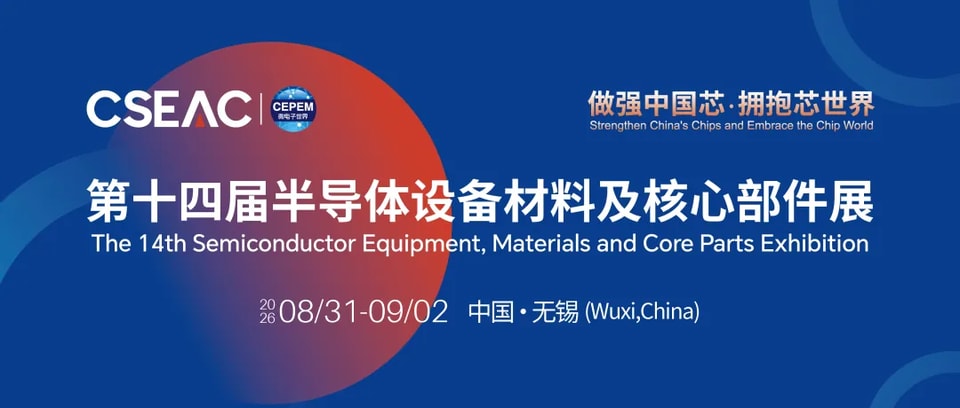
Opening in 27 days The 14th Semiconductor Equipment, Materials and Core Components Exhibition (CSEAC 2026) will be held from August 31 to September 2, 2026 at the Wuxi Taihu International Expo Center. Covering 70,000 square meters, with eight linked halls and 1,300+ exhibitors, it spans wafer manufacturing, packaging and testing, core components, materials and other fields. CSEAC brings together well-known companies from China and abroad and offers a rich program of concurrent events, giving a more complete picture of developments in the semiconductor industry, a more timely grasp of current industry trends, and better preparation for the challenges and opportunities ahead! Industry colleagues are cordially invited to attend and join us in witnessing this annual celebration of China's semiconductor industry! △ Please scan the QR code above to go to the registration page △ Click to pre-register and enter the draw for great prizes Visitors who complete registration before August 25 can visit the exhibition and open forums free of charge and will also receive an exclusive entry into the prize draw: First prize: HUAWEI Mate X7 Second prize: magnetic fast-charging power bank Third prize: stylish handheld fan *The prize draw is open and transparent throughout. Results will be announced on site at the exhibition, and winners must attend in person to verify their identity and collect their prizes. CSEAC 2026 Exhibitor showcase Wuxi Awing Technology Co., Ltd. Wuxi Awing Technology Co.,Ltd Booth: A3-150 Company profile: Founded in 2017, Wuxi Awing Technology Co., Ltd. specializes in the development and practical application of plasma cleaning equipment and process technology, focusing on the niche field of surface treatment for precision manufacturing. Building on its team's more than twenty years of accumulated industry expertise, the company has independently developed a range of RF/microwave plasma cleaning systems that meet a variety of process requirements, including organic contaminant removal, metal oxide reduction and material surface activation, and suit diverse production scenarios such as IC packaging, IGBT power devices, optical modules, LEDs, medical devices and specialty engineering materials. The company is certified to the ISO9001 quality management system and is backed by authoritative recognitions including National High-tech Enterprise, provincial- and municipal-level Specialized and Innovative Enterprise, Gazelle Enterprise and Jiangsu Province Private Science and Technology Enterprise. As room for growth in the precision cleaning industry continues to widen, Awing will keep deepening its process innovation and, drawing on its strengths in technology and service, provide one-stop solutions to production problems such as micro-contamination of workpieces, poor adhesion and oxidation failure, helping customers improve product yield and achieve long-term mutual success. Main product name: In-line microwave plasma cleaning and reduction system Product application: Integrated circuit packaging Technical specifications: Array microwave source: 2.45GHz, maximum power 2000W or 3000W (optional) PLC + industrial PC control, multi-recipe management mode Water contact angle Code reading and code scanning functions Process application: Copper lead frames oxidize very easily, and the oxide layer directly causes bonding failure, adhesion delamination and reduced product reliability. The system uses a mature argon-hydrogen mixed-gas plasma process to reduce and remove Cu₂O and CuO oxide layers from the surface of copper lead frames, restoring the solderability of bond pads, and strips various organic contaminants such as mold release agents, grease and micro-particles. It is widely used for pretreatment of power devices, optical module TOSA/ROSA, and copper lead frames in IC packaging. Click here to view more product details *The CSEAC Organizing Committee reserves the right of final interpretation of the registration campaign. Contact us Contact us 👇 Click “Read the original” to go directly to the CSEAC official website Read the full article

Introduction: a revolution in cleaning technology In this era of rapid technological development, the cleaning industry is not lagging behind. When it comes to modern cleaning technology, the microwave plasma cleaner stands out as one of the best. This equipment is not only efficient and environmentally friendly but can also meet a wide range of cleaning needs, which is truly impressive! What is a microwave plasma cleaner? A microwave plasma cleaner is a new type of cleaning equipment that combines microwave technology with plasma principles. It uses microwaves to excite a gas and ionize it into a plasma, which produces a powerful cleaning capability. Working principle: it sounds complex, but it is actually simple! At first, the name “microwave plasma cleaner” may sound mysterious. In fact, its working principle can be summarized simply and clearly in a few steps: Microwave excitation: The microwave generator inside the equipment emits microwaves that excite the gas. Plasma generation: Microwave energy ionizes the gas molecules, forming a plasma. Contaminant removal: Active particles in the plasma react with surface contaminants and break them down into small molecules, which are ultimately removed. See, its working principle really is that simple and clear. Truly a marvel of technology! Applications: a cleaning assistant that is everywhere Microwave plasma cleaners have a wide range of applications covering almost every industry. Here are some of the main application areas: Semiconductor manufacturing: In chip production, cleaning silicon wafers is critical, and microwave plasma cleaners can effectively remove surface impurities. Medical devices: Cleaning and disinfecting medical devices is an important step in ensuring safety, and the high efficiency of microwave plasma cleaners provides strong support for the industry. Automotive industry: Cleaning equipment is equally indispensable in the production and maintenance of auto parts, and microwave plasma cleaners perform excellently in removing oil and impurities. It is fair to say that it is a “cleaning expert” across many industries. Truly impressive! Advantages: why choose a microwave plasma cleaner? So what exactly are the advantages of using a microwave plasma cleaner? High efficiency: Compared with conventional cleaning methods, microwave plasma cleaners greatly improve cleaning efficiency, saving time and labor. Environmental friendliness: This cleaning method does not require large amounts of chemical cleaning agents, reducing environmental pollution. Precision: Treatment can be matched to different materials and contaminants, ensuring the cleaning result. With this whole range of advantages, it is truly hard to resist! Conclusion: toward a new era of cleaning As technology continues to advance, microwave plasma cleaners will demonstrate their powerful cleaning capability in more fields. Whether in industrial production or in daily life, this cleaning equipment will become a capable assistant in our cleaning work. Looking ahead, we look forward to more surprises from technology!
Introduction: a new era of cleaning technology In this era of rapid technological development, cleaning technology keeps advancing as well. The microwave plasma cleaner, a new type of cleaning equipment, is gradually being adopted across many industries. Today we look at its application scenarios and see how it is changing traditional cleaning methods. 1. A capable assistant for the electronics industry Cleaning is a critical step in the production of electronic products. Microwave plasma cleaners effectively remove surface contaminants and improve product reliability. In semiconductor manufacturing in particular, the microwave plasma cleaner's distinctive cleaning principle allows it to thoroughly clean the finest details without damaging components, making it a real “lifesaver” for the electronics industry. 2. Safety assurance for medical devices The medical industry's cleaning requirements are a matter of “high standards and strict demands”. With its excellent disinfection capability, the microwave plasma cleaner is widely used to clean all kinds of medical devices. From surgical instruments to diagnostic equipment, it ensures that every detail is sterile, truly delivering “worry-free cleanliness”. 3. A cleaning revolution in automotive manufacturing In automotive manufacturing, the cleaning process often affects the quality of subsequent painting and assembly. With its efficient cleaning capability, the microwave plasma cleaner has become an important partner on automotive production lines. It removes grease, dust and other impurities, ensuring that every component is as clean as new: a true “cleaning expert of the automotive world”. 4. A new cleaning option for the photovoltaic industry With the rise of renewable energy, the photovoltaic industry has developed rapidly, and microwave plasma cleaners play an indispensable role in the production of PV modules. They effectively remove dirt from the surface of PV panels, improve the power generation efficiency of PV modules and help achieve “green energy” goals: a real “cleaning whiz of the PV world”. Conclusion: limitless possibilities ahead Efficient and environmentally friendly, the microwave plasma cleaner is demonstrating its unique value in more and more fields. Whether in electronics, medical, automotive or photovoltaics, it keeps driving progress and development across industries. We look forward to seeing how it performs in even more application scenarios in the future, bringing more surprises and convenience.
Revealing the amazing working principle of microwave plasma cleaners In today's industrial cleaning field, microwave plasma cleaners have attracted wide attention for their unique cleaning results and efficient working principle. So how exactly does this remarkable equipment work? Let's lift the veil together! 1. What is a microwave plasma cleaner? As the name suggests, a microwave plasma cleaner combines microwave technology and plasma technology, and is an emerging type of cleaning equipment. It uses microwaves to heat a gas and ionize it, forming a plasma that then cleans the surface of an object. This cleaning method is not only efficient but also environmentally friendly, and it is gradually becoming a new favorite for cleaning across industries. 2. The working principle in detail The working principle of a microwave plasma cleaner can be divided into several steps: Gas conversion: First, the gas inside the cleaner (such as oxygen or nitrogen) is heated by microwaves, causing its temperature to rise rapidly. Once the gas reaches a certain temperature, it ionizes and forms a plasma. Plasma generation: At this point, atoms or molecules in the gas are excited and release electrons, forming a charged plasma. The plasma is highly active and can effectively remove dirt and contaminants from object surfaces. Cleaning process: Under the action of the plasma, contaminants are broken down into tiny gas molecules or atoms, which are finally carried away by the gas flow, completing the cleaning. Wow, doesn't that sound amazing? This process is not only efficient but also avoids the surface damage that traditional cleaning methods can cause. 3. Advantages of microwave plasma cleaners Compared with traditional cleaning equipment, microwave plasma cleaners offer many remarkable advantages: Efficient cleaning: Fast cleaning speed; complex cleaning tasks can be completed in a short time. Environmentally friendly and pollution-free: After ionization, the gases used cause no secondary pollution, reducing the impact on the environment. Wide range of applications: Can be used in many fields such as electronic components, medical devices and optical equipment, meeting the needs of different customers. In short, the microwave plasma cleaner is an efficient, environmentally friendly cleaning solution that is gradually changing the face of the traditional cleaning industry. 4. Application examples In practical applications, microwave plasma cleaners have already shown their unique value. For example, in semiconductor manufacturing, microwave plasma cleaners can effectively remove impurities from silicon wafers and improve product yield. In medical device production, their pollution-free nature ensures product safety and reliability. The microwave plasma cleaner is therefore not only a product of technological development but also an important tool driving progress across industries. 5. Summary Overall, with its unique working principle and notable advantages, the microwave plasma cleaner is providing solutions for the cleaning needs of all kinds of industries. In the future, as technology continues to advance, this type of equipment will become more widespread and become standard equipment in the cleaning industry. If you are still struggling to choose cleaning equipment, why not consider this emerging technology? We believe it will bring unexpected surprises to your work!
Exploring the amazing world of microwave plasma cleaners In today's era of rapid technological development, cleaning technology is not falling behind. As an emerging type of cleaning equipment, the microwave plasma cleaner is gradually coming into view. So what exactly is it? And why has it made such waves in the cleaning industry? Basic principle of the microwave plasma cleaner As the name suggests, a microwave plasma cleaner combines the advantages of microwave technology and plasma technology. It uses microwave heating to ionize a gas and form a plasma, which then effectively removes contaminants from object surfaces. This cleaning method is not only fast but also reaches into tiny gaps, with remarkable cleaning results. Wow, doesn't that sound impressive? Wide range of applications, unlimited prospects Microwave plasma cleaners are widely used in many industries. For example, in the electronics industry, they can precisely clean tiny impurities from circuit boards; in the medical industry, they can efficiently remove organic matter and bacteria from instruments, ensuring that the instruments are sterile. In addition, demand for these cleaners is also growing in fields such as automotive and aviation. It is truly a cleaning tool that “goes with everything”! Technical advantages, energy-saving and environmentally friendly Compared with traditional cleaning methods, microwave plasma cleaners have significant technical advantages. Not only is their cleaning efficiency high, but the cleaning process requires almost no chemical cleaning agents, making it truly environmentally friendly. Add to that their low energy consumption, and companies can reduce costs while also contributing to environmental protection. It is a cleaning solution that “gets twice the result with half the effort”, one that users can hardly put down. Market outlook: huge potential With the development of technology, the market outlook for microwave plasma cleaners is becoming ever broader. According to data from market research institutions, market demand for microwave plasma cleaners will show explosive growth in the coming years. Major companies are stepping up investment in research and development to seize the market lead. Imagine: the cleaning industry of the future may be completely transformed by this technology! User experience: trustworthy Many users of microwave plasma cleaners say that the cleaning results exceeded their expectations. During cleaning, the equipment is simple and convenient to operate, greatly improving work efficiency. Users praise it: “This is a really good helper!” In the cleaning industry, microwave plasma cleaners have won more and more trust with their outstanding performance. Summary: a promising future In summary, as a new generation of cleaning equipment, the microwave plasma cleaner is rising rapidly thanks to its unique technical advantages and broad application prospects. It not only drives technological innovation in the cleaning industry but also brings us a greener, more efficient cleaning experience. In the future, microwave plasma cleaners are bound to excel in more fields, and they are well worth looking forward to!
With accelerating industrialization and growing environmental awareness, demand in the cleaning industry is also growing. Traditional cleaning technologies have problems such as consuming large amounts of water and polluting the environment with chemicals, creating an urgent need for more environmentally friendly and efficient cleaning technologies. As a new technology in the cleaning industry, the microwave plasma cleaner has attracted wide attention in the market for being fast, efficient and environmentally friendly. The microwave plasma cleaner uses microwave heating and plasma energy to break apart dirt molecules instantly, achieving rapid cleaning. At the same time, it requires no chemicals and saves water, meeting today's requirements for cleaning technology. In fields such as automotive manufacturing, electronics and aerospace, microwave plasma cleaners have begun to be widely used, greatly improving cleaning efficiency and reducing cleaning costs. As the technology continues to develop and innovate, the market share of microwave plasma cleaners in the cleaning industry will keep growing, making them one of the future directions of cleaning technology. At the same time, the industry needs to keep strengthening technology R&D and improving product quality to meet market demand and promote the development of clean production.
Plasma cleaning technology can remove particulate contaminants from material surfaces, making the surfaces better suited to bonding or printing. The contaminants removed are mainly particulate contaminants such as organic matter, epoxy resin, photoresist, oxides and micro-particle contaminants. So how can the cleaning results be tested after plasma cleaning? Are there any simple methods? Before a plasma cleaner is used to treat products in batches, samples are usually treated first, and batch treatment of the products begins only after the results meet expectations, which better ensures efficiency. Among the many testing methods, water drop angle (contact angle) meter testing and dyne pen testing are the two most commonly used; there are also methods that use dedicated instruments or the results of special processes to reflect the cleaning results. A water drop angle meter is a contact angle meter, and contact angle measurement is currently one of the more common methods for evaluating plasma cleaning results. The cleaning result is assessed by comparing the change in the water drop angle before and after treatment: the smaller the water contact angle, the better the cleaning result. The specific method is as follows: before and after the sample is treated, place a drop of pure water on the sample surface, perform a 3D contact angle measurement through the microscope on the instrument to measure the drop angle each time, and compare the contact angles before and after to judge the cleaning result. This method gives accurate test data, is simple and quick to operate, and has high repeatability and stability, making it one of the commonly used testing methods. The water contact angle meter is a fairly common instrument for testing plasma treatment, but it is not suitable for testing all plasma-treated products. Materials differ in initial surface energy, and the reactions that take place on their surfaces after plasma treatment also differ. The cleaning results of most products can be tested with a water contact angle meter. One point to note is that when using the water contact angle test, the size of the water droplet should be kept similar for each test.
Specific maintenance of in-line plasma cleaners: 1. Check the vacuum pump oil level and oil purity. Check the vacuum pump oil level and oil purity every month by observing the oil level window. When the oil level approaches the lowest red line mark, top up to between the upper and lower red oil lines; observe the oil color. Normal oil is clean and transparent. When the oil is turbid (the oil turns gray or the oil level window becomes blurred) and the vacuum pump makes abnormal noise, replace the vacuum pump oil promptly. 2. Clean the reaction chamber of the in-line plasma cleaner. First wipe the vacuum chamber with a degreased cotton cloth moistened with anhydrous ethanol (commonly known as alcohol) (do not wipe the reaction chamber viewing glass with ethanol). Second, introduce gas into the chamber (argon + oxygen or nitrogen + oxygen) and use the plasma reaction to remove residues in the chamber. Do this at least once a month, for about 10 minutes each time. 3. For the plasma cleaner, check the integrity of the plastic tubing and the vacuum seal, and self-check the integrity of the equipment. After thoroughly cleaning the reaction chamber, prevent contaminants from leaking into the chamber. Check whether the sealing strip on the reaction chamber door is loose. Check whether every gas line is securely connected and whether it has aged. 4. Check the power supply of the vacuum plasma cleaner to make sure the voltage matches the equipment.
There are two types of in-line plasma cleaners: atmospheric-pressure in-line plasma cleaners and in-line vacuum plasma cleaners. The atmospheric-pressure in-line plasma cleaner is also low-temperature plasma treatment equipment and does not damage the material surface. It produces no arcing, requires no vacuum chamber and no harmful-gas extraction system, and is very widely used. Atmospheric-pressure plasma treatment machines treat materials with flat surfaces, or treat only a specific spot. An atmospheric-pressure plasma cleaner can treat materials 2m wide and can meet the surface treatment needs of most existing industrial materials, and it costs less than vacuum plasma. However, its parameters are harder to control, and it cannot handle irregularly shaped parts: many irregularly shaped parts cannot be treated on all sides. Compared with off-line vacuum plasma cleaners, in-line vacuum plasma cleaners have lower capacity. Because in-line vacuum plasma cleans a small quantity at a time, it is a higher-precision cleaning method and cleans more thoroughly and completely than off-line vacuum plasma. Off-line vacuum cleaning processes a large batch at once, and inevitably a few parts in the batch do not 100% meet requirements, whereas an in-line plasma cleaner cleans one or a few parts at a time, giving better cleaning results. In-line vacuum plasma can also deliver very high capacity, but the machine cost rises severalfold accordingly. In-line vacuum plasma cleaners suit industries that require high cleaning precision but do not have very large volumes; for example, some LED bracket applications use in-line vacuum plasma, and shoe machines also use in-line vacuum plasma.
A plasma cleaner basically consists of a power supply, matching network, chamber, solenoid valves, flow meters, external gas supply, vacuum pump and control circuit. When a fault alarm occurs, we should first use the alarm prompt on the screen to see which part has triggered the alarm, which identifies the approximate location of the fault, and then check whether the actuators in that part are abnormal. For control circuit faults, the most direct and simplest method is to test with a multimeter, checking for short circuits or open circuits and whether the voltage and current are normal. If you need to troubleshoot without a multimeter, the fastest method is substitution: first use the screen prompt to roughly locate the fault, then replace the suspect part with an identical component. If the fault lies in an electrical component such as an AC contactor, thermal overload relay, intermediate relay, phase sequence protector or flow meter, this quickly solves the problem. If there is a gas under-pressure alarm, you need to confirm whether gas is connected to the relevant gas inlet, whether the gas pressure, pressure regulator, flow meter, solenoid valve and analog wiring are all OK, and whether the related parameter settings on the screen are all correct. When there is an alarm for the vacuum reading being too high or too low, first check the parameter settings. When the vacuum reading is too high and the parameter settings are OK, you need to check the chamber and piping for leaks and check whether the pump-down pressure of the vacuum pump is normal. The fastest way is to connect the vacuum gauge supplied with the equipment directly to the vacuum pump and measure whether the pump's pump-down value meets the standard. If the pump-down value is normal, the vacuum pump is fine. Then connect the gauge to the pumping line and measure again; if the reading is much higher than when the gauge is connected directly to the vacuum pump, the pumping line is leaking. A pumping line leak may be at a pipe joint or caused by damage to the pipe. Although the pumping line is made of stainless steel, if it shakes during each pump-down and rubs against some nearby part, over time it can also wear through. If there is no obvious difference between the vacuum reading measured on the pumping line and that measured directly on the vacuum pump, the pumping line is also fine, and the only remaining step is to look for the leak in the chamber sealing. Possible chamber leak points are the sealing strip, the glass window, the connection between the pumping port and the outside, the connection between the electrode and the outside of the chamber, and the connection between the chamber vent and the outside; the most likely leak points are the sealing strip and the glass window. Faults in the power supply and matching network will also display related prompt messages in the alarm window on the screen when triggered, but false alarms can sometimes be triggered by parameter settings and other causes, which must be analyzed case by case. When the power supply or matching network fails, first confirm that the parameter settings are all correct, then check whether the wiring and the voltage signal that sets the power output are correct and reasonable, and whether serial communication between the matching network and the power supply is normal. Then debug manually: if, when adjusting the matching network parameters, the relevant parameters do not change noticeably when the increase/decrease buttons are pressed, the matching network is faulty; if the power output does not change when the power level is adjusted, the power supply is faulty.
Want to talk it through?
Tell us about the part and the surface problem. An engineer replies by email.

Inquiry
Send us a message.
Fields marked * are required. Details about the part, the material and the process help an engineer give a useful first reply.